
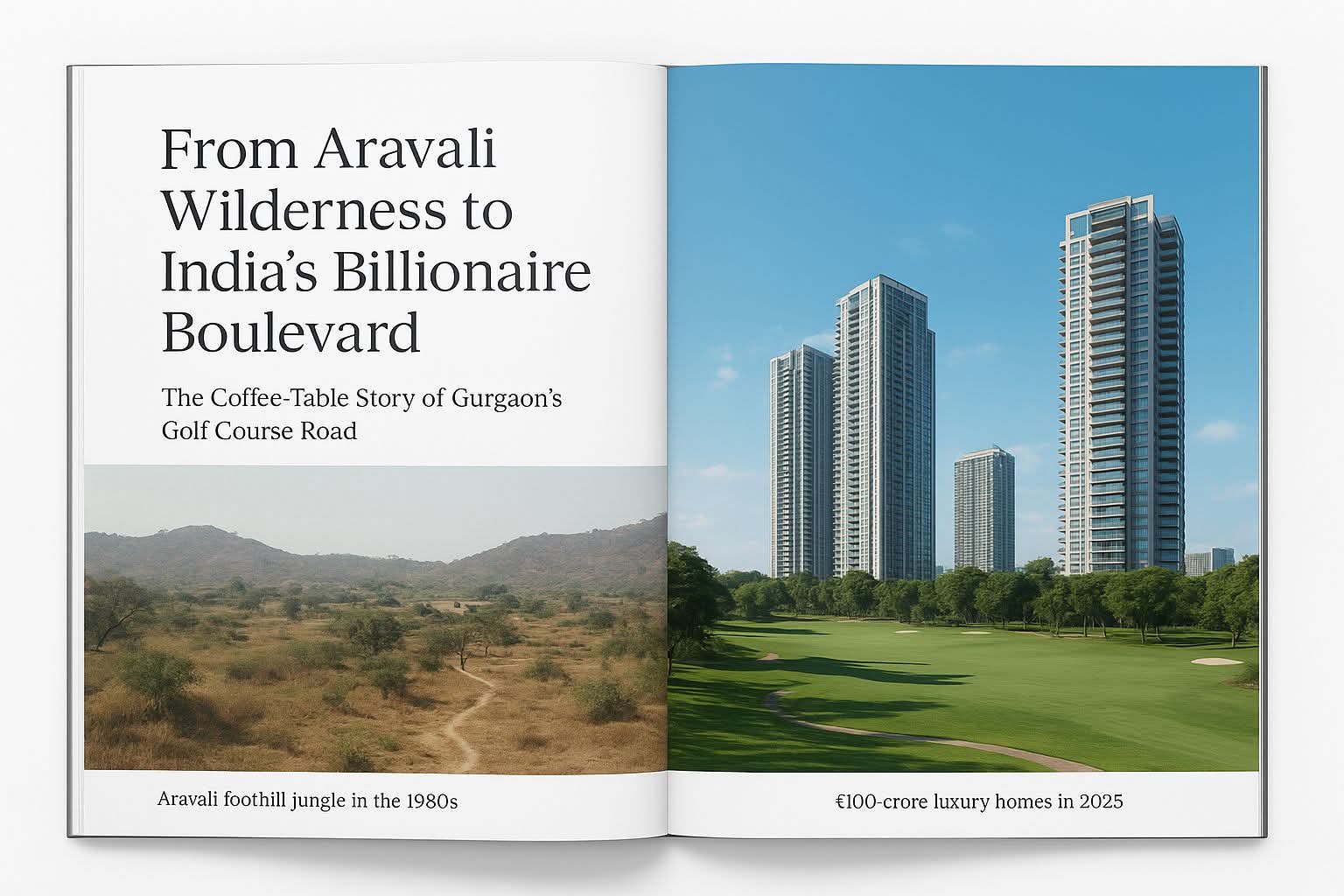

From Aravali Wilderness to India’s Billionaire Boulevard. –
The Coffee-Table Story of Gurgaon’s Golf Course Road.
In the early 1980s, the Aravali foothills rolled out in shades of brown and green — thorny scrub, shallow ponds, and buffalo trails cutting through forgotten fields. A haze of dust hung over villages like Wazirabad and DLF Qutub Enclave’s earliest sectors. Delhi was near, but this land felt like another world: rural, unhurried, untouched by ambition.
Few would have guessed that these very hills would soon cradle glass towers, private clubs, and homes that would one day sell for ₹100 crore and beyond.
The story begins with a vision. K.P. Singh of DLF looked out at this barren land and saw not what it was, but what it could be. While Delhi was bound in the red tape of planning restrictions, Singh imagined a parallel city — one built on speed, scale, and aspiration. Quietly, parcel by parcel, DLF acquired land from local farmers, sketching the foundations of what would be called DLF City.
The turning of the page came in 1999, when the DLF Golf and Country Club opened its gates. An Arnold Palmer signature course carved into the Aravali foothills, it was India’s first of its kind: a manicured world of greens, clubhouses, and a professional golf academy. More than sport, it was a symbol — a statement that Gurgaon was no longer just a satellite town. It was a lifestyle destination.
Around this nucleus, the skyline began to rise. The Aralias arrived first, elegant towers with sweeping views of the golf fairways. The Magnolias followed, redefining urban luxury with club-level exclusivity. Then came the crown jewel: The Camellias, where sky-villas touched the clouds and a penthouse recently fetched an astonishing ₹190 crore — making headlines across India.
Golf Course Road was no longer a road. It had become an address, a synonym for power and prestige. Glass towers mirrored each other, luxury cars glided past manicured medians, and a new Gurgaon emerged: one of private equity titans, expat executives, and global ambitions.
Yet, behind the gloss lay shadows. The villages that once owned these lands were caught in disputes, compensation battles, and courtrooms. Political strings pulled, permissions were rushed, and questions lingered: could a city built this fast, this ambitiously, ever escape controversy? But Gurgaon was relentless. Like its skyline, it pushed upward, past doubt, past criticism.
By the 2000s and 2010s, Gurgaon was no longer a satellite city. It was India’s business hub, its real estate laboratory, its boldest gamble. Today, Golf Course Road is valued not just in rupees, but in reputation. To live here is to belong to the rarefied top tier — where apartments are priced in tens of crores, where a square foot costs more than farmland once did per acre, and where exclusivity is the currency.
The Aravalis still stand, watching silently. From jungle scrub to billionaire boulevard, they have witnessed one of the most dramatic transformations of Indian urban history. Gurgaon’s Golf Course Road is more than a corridor — it is a metaphor for modern India: daring, conflicted, glittering, and unstoppable.